Welcome. The Tartan Dictionary exists to support the living Scottish Celtic tartan tradition — to help you understand tartans, trace a family or clan tradition, and find your way to owning your own.
Tartan country reaches the Highland Line (Helensburgh–Stonehaven) as the 1745 Memorial found it; the Lowlands and Borders wear the Shepherd/Falkirk check, England the Northumberland check.
After the 1822 royal-visit boom, tartan spreads south to the Southern Uplands.
The whole of Scotland in tartan, the border at the Solway–Tweed line; England in the Northumberland check.
Clan centroids and setts are a first pass; territory polygons traced from the 1899 Clans of Scotland map, and a true date slider, are the next layer.
Scotland in tartan — each clan's country filled with its own sett, the Lowlands and Borders in the Shepherd/Falkirk check. Toggle the era to watch tartan country advance from the 1745 Memorial's Highland Line to the whole of Scotland today. A first sketch: positions are approximate and a true date slider is still to come.
Most catalogues identify a cloth by its name, or by the weaver's exact thread-count recipe. This dictionary works one level up, at the pattern — the design itself, set apart from precise counts and shades — so that the many weavings of one design, across centuries and mills, are recognised as a single design. The Drummond of Megginch tartan, told apart at last from the Wilson "New Grant" it was long confused with, is the worked example.
Ways in
- Explore by pattern — browse the patterns and the tartans that express them.
- Trace a family tartan — find a clan or family and how its tartan has changed over the generations.
- Weave your own — the TTD navigator weaves any tartan in your browser, recorded or not, and finds its nearest existing neighbours.
- Match a logo — drop a logo or brand colours and find the existing tartans closest to it.
- Read the story — what tartan is, and where the tradition comes from.
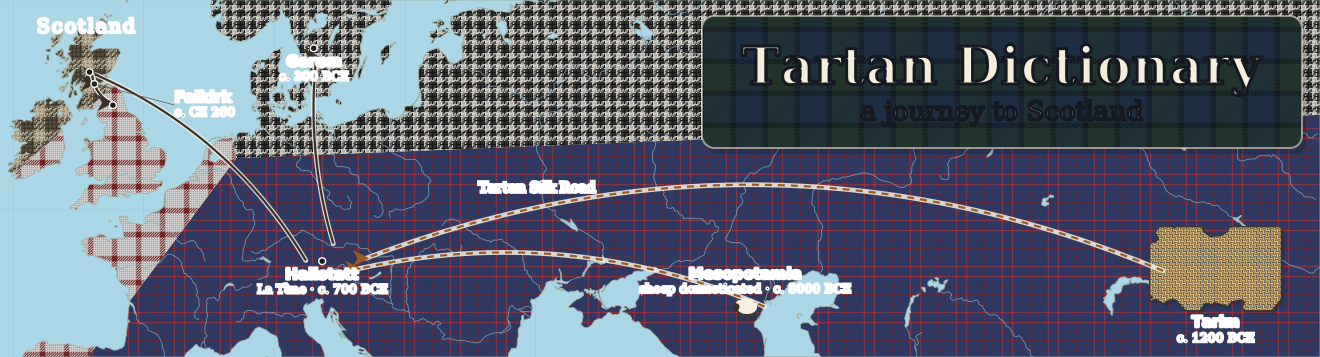
This is an early site, and it is growing. On the way: a public-good guide to weavers and makers so you can get your own — down to a kit to weave the oldest Scottish tartan of all. That oldest tartan, the Falkirk check of about 260 AD, is the cloth behind this page.