Scotland's oldest surviving tartan is not a clan sett, is not dyed, and very nearly did not survive at all. It came out of the ground as a wad of cloth stuffed into the neck of a Roman money-pot.
The find
On 9 August 1933, workmen levelling ground near Falkirk — a short way from the Antonine Wall — broke into a buried Roman earthenware jar. Inside were close to two thousand silver denarii, a coin hoard whose latest coins date its burial to around AD 230, in the first half of the 3rd century. The cloth had been pushed into the mouth of the pot as a stopper, and that is the only reason a scrap of third-century wool survived to be found at all. Hoard and cloth are both now in the National Museum of Scotland.1
The cloth
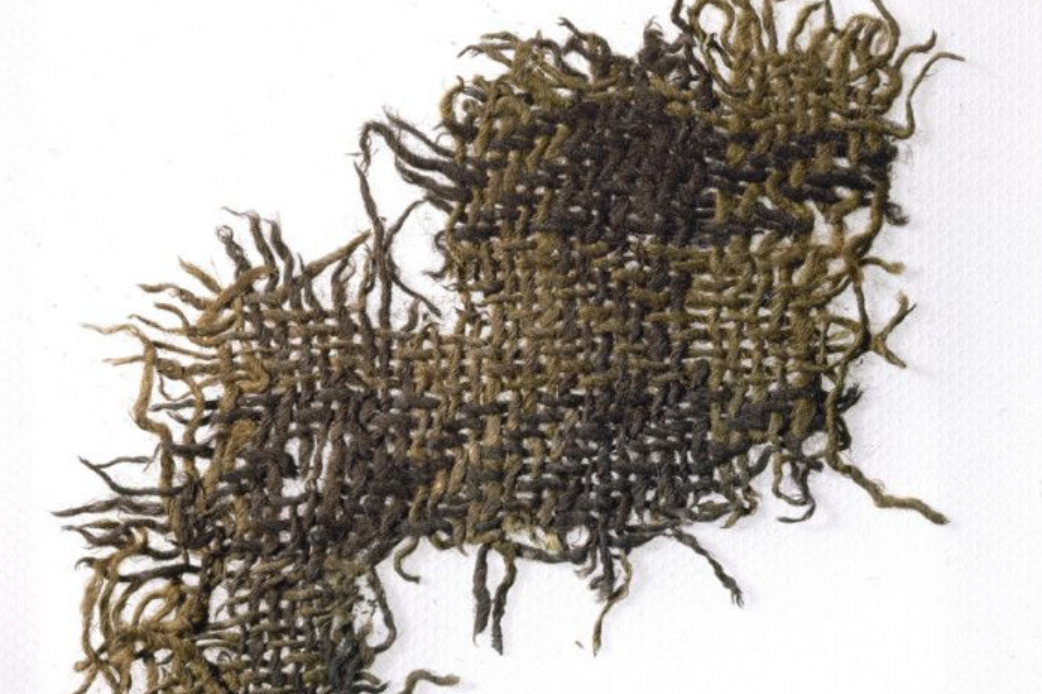
What survives is a small two-colour check — the Falkirk sett. It is woven as a 2/2 twill, the same diagonal-ground weave that runs through the whole deep history of tartan, in a simple check of roughly eight threads each way. The colours come entirely from the natural fleece: one dark-brown wool and one pale, faintly greenish cream. There is no dye in it at all.2
The pattern is the simplest a two-colour twill can make. Light crosses light to give a pale square, dark over dark a dark one, and where they cross you get the broken diagonal "teeth" of what later weavers would call shepherd's check or dog-tooth — the seed from which the elaborate, many-coloured setts eventually grow. One small weaver's detail worth keeping: the Falkirk yarn is Z-spun, where most modern tartan thread (Lochcarron's, for instance) is S-spun — the difference is simply the direction the fibre was twisted as it was spun.3
An older Scottish thread — the Oakbank crannog
Falkirk is the oldest surviving check in Scotland, but it is not the oldest surviving Scottish cloth. Some six centuries earlier, around 400 BC, a household living on the Oakbank crannog — an Iron Age timber roundhouse built out over the water of Loch Tay — was weaving wool too, and a fragment of it has been recovered from the loch bed.4
It makes a useful counter-example. The crannog cloth is not a 2/2 twill but a 2/1 twill — the minority structure, the one tartan did not settle on. So the two oldest Scottish textiles pull in slightly different directions: the older Oakbank piece shows that 2/1 was woven here too, while the later Falkirk sett is the one that sits squarely on the main line — the 2/2 twill that became the tartan norm. The deep tradition is broader and messier than a single straight thread; Oakbank is the reminder.
Why it matters
The Falkirk sett is the bridge between two worlds. Behind it lies the prehistoric and Roman 2/2-twill tradition — the dyed checks of Hallstatt, the diamond twills of Vindolanda. Ahead of it lies the historical Scottish tartan. What Falkirk shows is that by the 3rd century AD, weavers in Roman-period Scotland were already using the 2/2-twill ground to make patterned checks from natural-colour wool alone. The loom, the weave and the check principle are all there. The dye-pots and the named clan setts come much later — but the cloth is already, recognisably, the start of tartan.
See also The Origins of Tartan for the long view, and What is Tartan? for the definition.
"The Falkirk Tartan", Our Stories Falkirk. https://ourstoriesfalkirk.com/story/falkirk-tartan — and Falkirk Local History Society, "Falkirk Tartan and the Roman Coin Hoard". https://falkirklocalhistory.club/historical-objects/falkirk-tartan-and-roman-coin-hoard/ ↩︎
G. M. Crowfoot, "Two Textiles from the National Museum, Edinburgh", Proceedings of the Society of Antiquaries of Scotland 82 (1950), 225–231 — the technical analysis of the Falkirk cloth (alongside the Balmaclellan twill). https://journals.socantscot.org/index.php/psas/article/view/8306 ↩︎
Falkirk Local History Society, examination of the weave (Z-spun yarn). https://falkirklocalhistorysociety.files.wordpress.com/2019/02/object-4-falkirk-tartan.pdf — see also J. P. Wild, "The Textile Industries of Roman Britain", Britannia 33 (2002), 1–42. ↩︎
"Textile from the Crannog: analyses and weave experiment of a 2/1 twill weave from Oakbank, Scotland, 400 BCE" — the local Iron Age 2/1 twill from the Oakbank crannog, Loch Tay. https://www.academia.edu/96109929/ ↩︎