Centuries before the Falkirk sett — and in full colour where Falkirk makes do with undyed fleece — Iron Age Celts were already weaving the combination at the heart of countless later tartans: a dark blue ground crossed by a fine red check. The cloth that proves it came out of a salt mine in the Austrian Alps.
The find
The Dürrnberg salt mine, above Hallein near Salzburg, is the successor to the more famous Hallstatt workings a little to the east. As Hallstatt's Early Iron Age heyday faded, Dürrnberg took over as the economic centre of the region; its galleries were worked from the late Hallstatt period into the La Tène period — the later Iron Age culture, from about the mid-5th century BC, whose name has become shorthand for the Celts of continental Europe.1
Salt is a near-perfect preservative, and the mine has yielded what is now reckoned the biggest pre-Roman textile complex in Europe: over six hundred distinct textiles from the galleries, plus some two hundred mineralised fragments from the graves around the mountain — everyday working cloth, not funeral finery, dropped and lost by the miners themselves.2
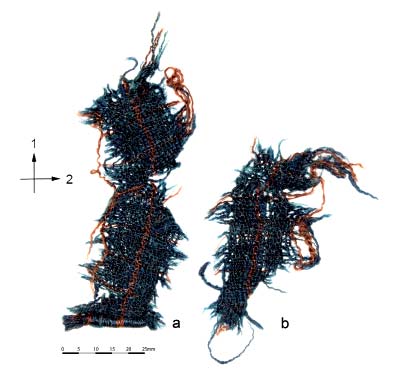
Among them is textile 2375: two fragments of fine dark-blue wool, crossed in both directions by thin red pattern threads — a chequered pattern, in the excavators' careful language. In a tartan dictionary we may be permitted the bolder word. A dyed blue ground with a red overcheck is, structurally, a tartan sett — the same skeleton as a modern "blue ground, red line" tartan, woven by La Tène Celts well over two millennia ago.3
The cloth around it
The Dürrnberg corpus puts the check in context, and the context is sobering for anyone picturing whole clans of tartan-clad Iron Age Celts:
- About 72% of the textiles are wool, 26% flax. The linens are all plain weave; the wools split between plain weave and 2/2 twill — the very twill that became the tartan ground — with no other twill variant found in the mine at all.4
- Of the patterned cloth, stripes dominate at 57%; warp-and-weft colour effects make another 29%. True chequered patterns are just 8% — the researchers note that "the otherwise concise image of the Celts in the chequered pattern can most probably be revised on the Dürrnberg". Checks like 2375 were the exception, not the uniform.5
- The dominant dye is blue — the distinctive "Dürrnberg dark blue", which microscopy shows was achieved by dyeing very pale fleece, not by starting from dark wool. Reds and greens are rarer; and in some fabrics red and blue fibres were deliberately blended so the cloth shimmers towards purple — a knowing imitation of Mediterranean murex purple, the most expensive colour in the ancient world.6
So the La Tène weavers had the whole kit: the 2/2 twill, strong dyes, and the check principle — they simply used the check sparingly, as one design among several.
Why it matters
Set beside the other ancient cloths in this Dictionary, Dürrnberg 2375 completes a pattern. The Tarim and Hallstatt finds show the dyed twill check deep in prehistory; 2375 carries it into the La Tène period — the culture most directly ancestral to the historical Celts — as a blue-and-red colour scheme any modern mill would recognise; and Falkirk, centuries later again on Scottish soil, shows the same check principle worked in undyed fleece. The thread from Iron Age Austria to the Scottish tartan is not a single unbroken line — but every strand of the craft is already in these fragments: twill, dye, and the crossing bands of colour.
See also The Origins of Tartan for the long view, The Falkirk Tartan for Scotland's oldest check, and What is Tartan? for the definition.
Ronja Lau, "Textile archaeological analyses of the finds from the Dürrnberg salt mine", Archaeological Textiles Review 66 (2024), 24–28 — Dürrnberg "dates mostly to the early La Tène period and was the economic centre of the region", usually regarded as the replacement of Hallstatt. https://atnfriends.com/ ↩︎
Lau, ATR 66, 25 and 28: c. 567 distinct textiles catalogued from the 1970–2000 excavations alone, over 600 estimated, plus ~200 mineralised grave fragments — "the biggest pre-Roman textile complex in Europe". ↩︎
Lau, ATR 66, fig. 4: "Textile inventory number 2375, dark blue textile fragments with a red chequered pattern (Image: Ronja Lau/Keltenmuseum Hallein)". ↩︎
Lau, ATR 66, 25: linen exclusively plain weave; wool plain weave "in strong competition with 2/2 twill fabrics. No other twill variants have yet been identified." ↩︎
Lau, ATR 66, 27: four pattern categories — stripes 57%, colour effects 29%, chequered 8%, plus rare spin patterning (common at Hallstatt, so possibly the oldest pieces). ↩︎
Lau, ATR 66, 26: natural browns c. 52% of the corpus, blue c. 17% and dominant among the dyes; Dürrnberg dark blue dyed on very light fibres; red-and-blue fibre blends imitating murex purple as a display of wealth. ↩︎