"For the purposes of this Act, a tartan is a design which is capable of being woven consisting of two or more alternating coloured stripes which combine vertically and horizontally to form a repeated chequered pattern."
— Scottish Register of Tartans Act 2008, section 21
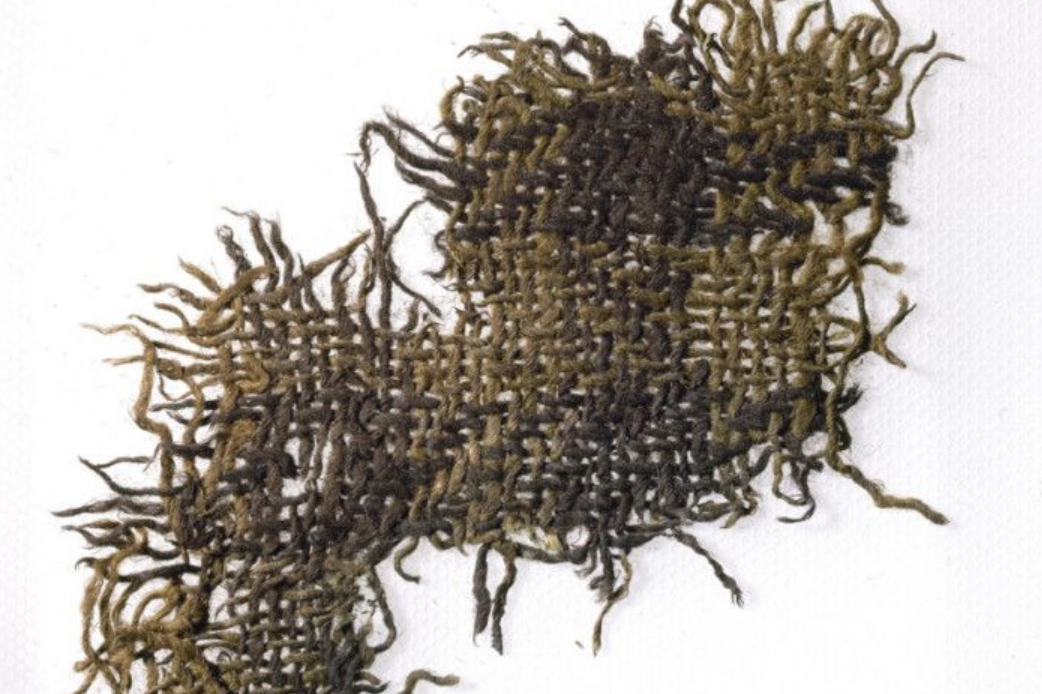
This is how the Scottish Parliament defined tartan when it set up the Scottish Register of Tartans. It is the end of a journey that begins in ancient Eurasia. This post follows that whole line: from the birth of weaving to its eventual flowering, much later, in Scotland into a joyful way of celebrating cultural and family identity.
Looms to Twill
People were dressed long before they could weave. The neatest clue to when we first put on clothes is a faintly absurd one — lice. At some point the body louse split off from the head louse and took to living in clothing rather than on the scalp, which it could only do once there were clothes to live in; dating that split by their genetics puts the first clothing somewhere between 40,000 and 170,000 years ago.2 Whatever the true figure, those first clothes were not woven at all — they were animal skins and furs, and skins stayed the humble end of the wardrobe for a very long time. Even in the cities of ancient Sumer, ordinary winter dress was still sheep fur, while finer woven wool marked you out.3
Weaving did not begin on a loom. The oldest textile we have was made entirely by hand — plant fibre twined, looped and knotted into cloth, found in Guitarrero Cave high in the Peruvian Andes and roughly twelve thousand years old.4 It belongs to a New World tradition with no connection to the Old World story whatsoever, and that is the telling part: cloth was plainly invented more than once, by people who never met. Weaving is not one culture's idea that spread — it is something humans reach for wherever they settle.
The loom, and the plain tabby cloth that comes off it, appears later — and in a different fibre in each part of the world:
- Anatolia — the oldest loom-woven cloth in the Old World, from Çatalhöyük, around 6700 BC: a plain tabby, woven (a recent surprise) not from flax but from oak bast, the inner bark of the tree.5
- Egypt and north-east Africa — flax linen. Egyptians were weaving it by about 5000 BC; a loom is even painted on a pottery dish from Badari (c. 3600 BC), and the linen Tarkhan Dress (c. 3400 BC) is the oldest woven garment found anywhere.6
- The Indus Valley — cotton. Cotton threads survive at Mehrgarh from about 6000 BC, and woven cotton cloth at Mohenjo-daro from about 3000 BC.7
- China — silk. Traces of silk protein appear in tombs at Jiahu some 8,500 years ago; the oldest surviving woven silk is from Qianshanyang, about 2700 BC.8 It appears in high-status graves: silk, and the dyeing of it, were marks of rank from the very start.
Different fibre, different corner of the world — and all of it plain weave. The upright warp-weighted loom that the whole later tartan tradition runs on belongs to this early world too — it is in Europe by the late sixth millennium BC — and at first it weaves plain cloth like everything else.9
twining and looping → the loom and plain tabby → twill → coloured, checked twill → the tartan sett
Twill comes later than all of it, and the checked twill that becomes tartan later still. The earliest twill check we have — the Tarim plaid of western China, the oldest thing that genuinely looks like tartan — is only about three thousand years old, more than five thousand years after that first loom cloth at Çatalhöyük. It has a post of its own: The Tarim Tartan.
One caution to carry forward. Cloth rots. It survives only where the ground is exceptionally dry, frozen, or waterlogged — a desert, a glacier, a salt mine, a bog. So the map of "oldest surviving textiles" is really a map of where cloth happened to last, not where it was first made. Almost everything from the wet, temperate places — which is to say almost everywhere people actually lived — is simply gone.
Twill and woolly sheep
Twill is a wool weave. That sounds like a small technical point, but it is the hinge of the whole story, because tartan is twill and twill, in practice, means wool.
I will be honest: I do not really know why twill and wool belong together — only that they plainly do. Across the early loom world the fibre and the weave line up. Egypt wove superb linen for three thousand years and kept it almost all plain, and what little twill turns up there usually marks wool or imported cloth; the Indus wove cotton and China silk, and both stayed overwhelmingly plain too. Twill, where it appears, travels with wool.10 The usual explanation is in the fibre: flax, cotton and reeled silk are smooth and fairly inelastic, content in an over-one-under-one tabby, while wool is springy, crimped and elastic — which is what the over-two diagonal of a twill seems to want, a cloth that drapes, gives a little on the bias and traps air to hold warmth. That may be the whole of it; but the pairing is clearer than its cause, and I would rather flag the connection honestly than pretend I can fully account for it.
But the wool had to be invented first. Sheep were domesticated early — around 11,000 to 9,000 BC in the Near East — though not for wool: they were kept for meat, milk and skins, and the first sheep were not woolly at all. A wild sheep wears a double coat, coarse hair over a short downy undercoat; the dense, single, ever-growing woolly fleece we now take for granted is a bred thing, selected over thousands of years. The breeding for wool seems to begin around 6000 BC, but real woven wool comes only two or three thousand years later — the oldest claimed wool is from the north Caucasus, around 3700–3200 BC — and it is the Bronze Age that pushes hardest for the dense, white, continuously-growing fleece that takes dye cleanly.11
And that is the moment everything tartan needs falls into place at once. A woolly sheep gives you a fibre springy enough to make twill worth weaving; one that comes ready-coloured — black, white, grey and brown straight off the animal — so a two-colour check costs nothing but sorting the fleece; and one that takes dye beautifully, so colour becomes a luxury you can add on top. The cheap cloth is the natural-fleece check; the dear cloth is the dyed one — the same split we saw between sheep-fur Sumerians and silk-wearing elites, now built into the wool itself. Diagonal twill, natural-colour checks, and dye for those who could afford it: every ingredient of tartan is on the table by the Bronze Age. What is left is to find it in the ground — which is where we turn next.
It is twill
The single most important technical fact about tartan is the one that is easiest to overlook: it is a twill. Plain weave crosses each thread over one and under one; 2/2 twill goes over two and under two, stepping the offset along by one thread each row, so the cloth carries a diagonal grain. That grain is why tartan drapes softly, gives a little on the bias, and shows its colours as the slightly blurred diagonal blocks we recognise. The Dictionary's whole scope is this family — 2/2-twill, horizontally-and-vertically symmetric setts — because holding the weave constant is what lets a pattern be a clean unit of meaning.
And it is the same 2/2-twill family at every point in the deep history:
- the Hallstatt salt-mine textiles of the eastern Alps (c. 800–400 BC),
- the Tarim Basin plaid of Xinjiang (c. 1200 BC) — see the companion post, The Tarim Tartan,
- and the woollens of Roman Britain, where at Vindolanda on Hadrian's Wall roughly two-thirds of the cloth is 2/2 diamond twill.12
There is even a neat division of labour by weave. Twill, the weavers of Hallstatt understood, has "better heat retention properties than tabby" and is "more pliable" — so it makes the garment, the cloak or tunic that must drape and keep you warm. The firm, dense rep (a warp-faced plain weave) was kept for the bands — head-bands, belts, borders, carrying straps — because it holds its shape.13 The body of tartan is twill; its edges are not.
A tradition that evolves — even its weave changed
It is tempting to imagine ancient tartan as our tartan, only older. It was not. The tradition has evolved at every level, and the clearest proof is that the weave itself changed.
Most tartan today is plain 2/2 twill, with all the interest carried by the dyed colour sett. The early evidence runs the other way: it prefers the more elaborate patterned-structure twills, with the colour often plainer. At Vindolanda the favourite was not plain twill at all but diamond twill (~62% of the cloth; plain 2/2 only ~5%) — Wild notes "diamond twill was the preferred structure, despite the extra demands which it makes upon the weaver."12 The Falkirk cloth is a herringbone; the Hallstatt corpus runs to herringbone, zigzag, pointed and diamond twills. Over time the complexity migrated from the structure into the colour: the weave simplified to plain 2/2, while the sett grew elaborate. (The older taste never died — plenty of cloth is still woven as herringbone, and herringbone rules in tweed.)
The same drift toward the simple twill shows up at the northern edge of the wool world. In the Norse North Atlantic the weaves "encountered varied through time, with most diversity in weaves found during Iceland's Viking Age … and rapidly declining so that the main weave types which dominate the assemblage in the early medieval period are the 2/2 twill and the tabby or plain weave."14 That initial exuberance of weaving styles — seen alike at Hallstatt, at Vindolanda and in the Norse settlements of Iceland and Greenland — gives way to simpler twills, and it is reasonable to suppose something similar happened in Scotland. The older, more elaborate structure was never wholly lost: the herringbone twill is kept alive to this day in the tweed of Harris.
The colour evolved too. The earliest checks lean heavily on the natural colours of the fleece — black, white, grey, brown — because dyed colour was expensive; a thin precious line of woad blue or madder red was set against broad fields of free natural wool. Only later does the dense, many-coloured dyed sett become the norm. And the very word is a latecomer: "tartan" is probably from Old French tiretaine, a cloth name, not a pattern; the native Gaelic for the pattern is breacan, "chequered". The earliest record of the word "tartane" in Scots is only 1538.15 A tradition this changeable in weave, colour and name is not a relic; it is alive.
The Indo-European thread — loosely
The most striking thing about the deep history is its geographic reach. The same idea — coloured checks and stripes on a 2/2-twill ground — turns up at both ends of the Indo-European-speaking world at roughly the same time:
- East: the Tarim Basin plaid (Xinjiang, c. 1200 BC), woven by Tocharian-speaking communities — a diagonal-twill check up to six colours, ~6,000 km from Scotland.16
- Centre: Hallstatt (c. 800–400 BC), the proto-Celtic salt-mining world of the eastern Alps, with dyed checks and dogtooth on 2/2 twill.13
- West / Atlantic: the British and Irish woollen tradition, the Falkirk check, and the Atlantic Celtic façade reaching down to Galicia in north-west Iberia.
The Greek and Roman writers saw it from the outside and remarked on it: Diodorus Siculus (drawing on the lost Posidonius) describes Gauls in striped cloaks "in which are set checks, close together and of varied hues",17 and Virgil has them "gleam in striped cloaks" (virgatis sagulis).18 (A caution for anyone reaching for the classics: Tacitus does not describe tartan-clad Britons — his coloured-cloth passage is about Germanic dress, not Celtic.)
But "Indo-European" here must be held loosely, and this is where older popular accounts go wrong. The link is one of shared craft and culture, not a single migrating people. The 2021 genome study of the Bronze-Age Tarim mummies found them to be a genetically isolated, indigenous population — not incoming Celts or steppe migrants.19 What travelled across Eurasia was the technology and the taste — woolly sheep and the twill-plaid check — spread by contact and a common cultural world, not a folk-migration carrying tartan east. The cloth is a shared inheritance, which is the better story anyway: a craft, not a flag.
The development of tartan in Scotland
The whole arc gathered into one view — not to scale (it cannot be), each stop given equal room, the colour chips running from natural fleece to dyed just as tartan's own palette did. The deep prehistory is behind us now; what follows is the Scottish end of the line.
- 170,000–40,000 years ago Clothing — skins and furs, dated by the body louse
- from c. 3500 BC Wool — woolly sheep bred from their hairy ancestors
- 1200–1650 Early Scots — Glen Affric, the oldest true Scottish tartan; "tartane" first recorded
- c. 1600–1745 Jacobite flourish — Highland dress at its height
- 1746–1782 Jacobite repression — the Dress Act bans Highland dress
- 1782–1901 Revival & Victoriana — Scott's 1822 pageant; Victoria at Balmoral
- 1996 / 2008 STA & the Register — the Authority, then the statutory Register
If the genesis is Eurasian, the flowering is unmistakably Scottish, and it is recent. The western branch of the tradition stayed alive in Highland Scotland, and there it grew into something the rest of the world did not have: a system of named setts tied to clan and place. The stages are worth keeping straight, because the popular story collapses them.
- 3rd century AD — the Falkirk sett. Scotland's oldest surviving scrap of check, a simple black-and-white twill of natural wool, kept by accident as a stopper in a pot of Roman coins. The cloth tradition is this old in Scotland; the clan system is not.
- 16th century — the Glen Affric tartan. Pulled from a peat bog and radiocarbon-dated to c. 1500–1600, this is the oldest surviving piece of true Scottish tartan — a multi-colour sett dyed with woad/indigo, madder and natural browns, with no synthetic dye.20 The same dye-pot the Tarim weaver reached for, two and a half thousand years later.
- 1538 — first in the records. The Treasurer's accounts of James V record "Heland tartane"; the word, and Highland tartan as everyday Highland dress, are now documented.15
- 1746–1782 — proscription. After the last Jacobite rising the Dress Act banned Highland dress, including tartan, in an effort to break the clan system. Repealed in 1782, it left tartan to be remembered and reinvented rather than continuously worn — a hinge in the story.
- 1822 — the pageant. George IV's visit to Edinburgh, stage-managed by Walter Scott as a sea of tartan, turned the cloth from a proscribed Highland habit into a national, romantic costume — and set off the demand that the mills would soon codify.
- late 18th–19th century — codification. Wilsons of Bannockburn, the great weaving firm, named patterns after towns, districts and people in their pattern books; the Highland Society of London began collecting and registering "clan" tartans from 1815; and the Sobieski Stuarts' Vestiarium Scoticum (1842) — a forgery — supplied a whole invented canon of clan setts that Victorian Scotland eagerly adopted. Victoria and Albert at Balmoral did the rest.
- today — the Register. The Scottish Register of Tartans now records the sett formally as a thread count, and over seven thousand designs are recorded. The clan-symbol layer that most people mean by "tartan" is, in other words, barely two centuries old — an Enlightenment-and- Victorian construction laid over a genuinely ancient cloth.
None of that makes the clan tartans inauthentic; it makes them the latest chapter of a long book. The Dictionary's whole approach — treating a tartan as a pattern rather than a single thread count or a single name — is really a way of seeing that long book as one continuous text, in which a 16th-century bog scrap, a Wilsons pattern-book sett and a modern registered design can be recognised as moments in one evolving tradition.
One popular notion is worth weighing here, because it is half true: the idea that more stripes meant more importance — that an elaborate, many-coloured sett was a badge of rank. As a rule it is a myth; there was no sumptuary code pinning stripe-counts to station. But it has a genuine root in cost. Every extra colour meant another dyestuff, another dip and another set of changes at the loom, and dyes — especially imported reds and the deepest blues — were dear. A broad, many-striped, many-coloured cloth was therefore simply expensive, and like any expensive thing it advertised the purse that bought it. The well-off could afford exuberance, and they wore it: across the eighteenth century the Highland gentry are painted in a riot of stripes, often in several different tartans at once. The c. 1739 portrait of James Moray of Abercairny by Jeremiah Davidson is the classic case — the laird stands in a single outfit that cheerfully combines distinct, complicated setts across plaid, jacket and hose, with no thought of matching them.21 The discipline of "one clan, one tartan" came later; the eighteenth-century taste was for more.
The honest position
Set strictly, the fully-developed, multi-colour symmetric sett that the definition requires survives first only at early-modern Glen Affric — so we should not claim ancient cloth was "tartan" outright. What we can say, and what the evidence strongly supports, is that every ingredient of tartan is ancient: the 2/2-twill ground, the colour-striping and checking of it, the natural-fleece palette, the diagonal-twill plaid at the far edge of the world, and the native breacan idea. Put together:
Tartan is the late Scottish naming and codification of an ancient, evolving, loosely Indo-European tradition of coloured striped twill — older in time, and wider in geography, than the Scottish story alone allows.
That is the line the Dictionary keeps: from Hallstatt — and, we can now add, from the Tarim Basin — through to today.
Companion piece: The Tarim Tartan takes the oldest surviving specimen and works a sett from it. See also What is Tartan?.
Scottish Register of Tartans Act 2008 (asp 7), s. 2, "Meaning of 'tartan'". https://www.legislation.gov.uk/asp/2008/7/section/2 ↩︎
The body louse lives in clothing rather than on the skin, so it could only evolve once humans wore clothes — which makes the genetic split between head and body lice a rough clock for when clothing began. Estimates run from 40,000 to 170,000 years ago (Kittler, Kayser & Stoneking; a 2003 study suggested ~107,000 years, a 2011 study ~170,000). History of clothing and textiles, Wikipedia. https://en.wikipedia.org/wiki/History_of_clothing_and_textiles ↩︎
In ancient Mesopotamia ordinary Sumerian dress was simple, with winter clothing made of sheep fur, while the tufted woollen kaunakes marked higher rank. History of clothing and textiles, Wikipedia. https://en.wikipedia.org/wiki/History_of_clothing_and_textiles ↩︎
Jolie et al. (2011), on the twined textiles and cordage of Guitarrero Cave, Peru; see Current Anthropology / summary at https://www.sciencedaily.com/releases/2011/04/110413121008.htm ↩︎
Rast-Eicher et al. (2021), "The use of local fibres for textiles at Neolithic Çatalhöyük", Antiquity. https://www.cambridge.org/core/journals/antiquity/article/use-of-local-fibres-for-textiles-at-neolithic-catalhoyuk/294D8367B55E0A752ACC1825035840FC ↩︎
Egyptian flax-linen weaving dates from c. 5000 BC; a loom is depicted on a pottery dish from Badari (c. 3600 BC), and the linen Tarkhan Dress (radiocarbon-dated 3482–3102 BC) is the oldest surviving woven garment. A. Stevenson & M. Dee, "Confirmation of the world's oldest woven garment: the Tarkhan Dress", Antiquity (Project Gallery). https://antiquity.ac.uk/projgall/stevenson349 ↩︎
Earliest cotton: mineralised cotton threads on a copper bead at Neolithic Mehrgarh, Pakistan, c. 6000 BC; the oldest woven cotton is a fragment adhering to a silver vase at Mohenjo-daro, c. 3000 BC. "First Evidence of Cotton at Neolithic Mehrgarh, Pakistan", Harappa. https://www.harappa.com/content/first-evidence-cotton-neolithic-mehrgarh-pakistan ↩︎
Biomolecular traces of silk fibroin in tombs at Jiahu, Henan, c. 8,500 years ago (Gong et al., PLOS ONE, 2016, https://pmc.ncbi.nlm.nih.gov/articles/PMC5152897/); the oldest surviving woven silk is from Qianshanyang (Liangzhu culture), c. 2700 BC. ↩︎
"The oldest loom-woven textiles from the Iberian Peninsula and the European loom", Scientific Reports (2021) — earliest Iberian loom cloth is flax tabby (Peñacalera, Córdoba, later 4th millennium BC); the warp-weighted loom reaches Central Europe in the late 6th millennium BC; all examined early examples are plain weave, with no twill. https://www.nature.com/articles/s41598-021-01349-5 ↩︎
Twill is warmer, more pliable and more elastic than plain tabby (K. Grömer, "Tradition, creativity and innovation: the development of textile expertise from the Bronze Age to the Hallstatt period", in Textiles from Hallstatt, 2013) — properties that suit springy wool, whereas smooth, inelastic linen sits more naturally in plain weave. https://www.academia.edu/11038057/ ↩︎
Sheep were domesticated c. 11,000–9,000 BC for meat, milk and skins; the single woolly fleece is a later bred trait — wild sheep have a double coat of coarse hair over a downy undercoat. Selection for wool may begin c. 6000 BC, with woven wool only two to three thousand years later, and dense white fleeces bred in the Bronze Age. "Domestication of the sheep", Wikipedia https://en.wikipedia.org/wiki/Domestication_of_the_sheep; "Approaching sheep herds origins and the emergence of the wool economy in continental Europe during the Bronze Age", Archaeological and Anthropological Sciences (2019) https://link.springer.com/article/10.1007/s12520-019-00856-x. The oldest claimed wool — contested — is from Klady (Majkop), north Caucasus, c. 3700–3200 BC (Shishlina et al. 2003) https://www.academia.edu/24477597/. ↩︎
J. P. Wild, "Vindolanda 1985–1988: The Textiles", Vindolanda Research Reports, New Series, Vol. III, 76–90 — diamond twill ~62%, plain 2/2 ~5%, ~20% of the cloth dyed. ↩︎ ↩︎
K. Grömer, "Tradition, creativity and innovation — the development of textile expertise from the Bronze Age to the Hallstatt period", in Textiles from Hallstatt (2013). https://www.academia.edu/11038057/ ↩︎ ↩︎
M. Hayeur Smith, "Dress, Cloth, and the Farmer's Wife: Textiles from Ø172 Tatsipataa, Greenland, with Comparative Data from Iceland", Journal of the North Atlantic, Special Volume 7 (2014), 64–81. https://doi.org/10.3721/037.002.sp607 ↩︎
Dictionary of the Older Scots Tongue, s.v. tartane — earliest quotation 1538. https://www.dsl.ac.uk/entry/dost/tartane ↩︎ ↩︎
Ancient Mummies of the Tarim Basin, Expedition Magazine, Penn Museum. https://www.penn.museum/sites/expedition/ancient-mummies-of-the-tarim-basin/ ↩︎
Diodorus Siculus, Library of History 5.30 (drawing on Posidonius). https://gaulishpolytheism.com/diodorus-siculus-on-gaul-book-5/ ↩︎
Virgil, Aeneid 8.659–661 (virgatis lucent sagulis), Perseus. https://www.perseus.tufts.edu/hopper/text?doc=Perseus:text:1999.02.0055:book=8:card=630 ↩︎
F. Zhang et al. (2021), "The genomic origins of the Bronze Age Tarim Basin mummies", Nature. https://www.nature.com/articles/s41586-021-04052-7 ↩︎
Scotland's oldest tartan discovered by Scottish Tartans Authority, V&A Dundee. https://www.vam.ac.uk/dundee/info/scotland-s-oldest-tartan-discovered-by-scottish-tartans-authority ↩︎
James Moray of Abercairny, by Jeremiah Davidson, c. 1739 — the sitter wears deliberately mismatched setts on plaid, jacket and hose, a fashion of the pre-proscription Highland gentry. See the discussion in Was Tartan Really Banned?, National Trust for Scotland (Culloden). https://cullodenbattlefield.wordpress.com/2017/03/10/was-tartan-really-banned/ ↩︎