Torridon Tweed
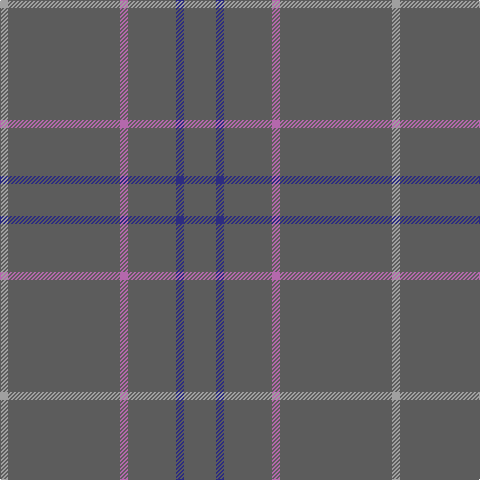
In pattern BBBRBY.
This was sourced from register-of-tartans. It is a 6 stripes tartan.
Original link https://www.tartanregister.gov.uk/tartanDetails.aspx?ref=5543
Thread count
N/8 Na112 P8 Na48 DB8 Na/32

Palette
Each colour and its ΔE from the base-6 reference it is a variant of.
| Colour | Shade | Base | ΔE (OKLab) |
|---|---|---|---|
| DB | #2C2C80 #2C2C80 | B #2C4084 | 0.05 |
| N | #A0A0A0 #A0A0A0 | Y #E8C000 | 0.20 |
| Na | #5C5C5C #5C5C5C | B #2C4084 | 0.14 |
| P | #B468AC #B468AC | R #C80000 | 0.21 |
Sample pattern
Nearest tartans
The nearest existing variants by ΔTartan distance.
- Burnett, of Leys hunting — ΔT 2.60
- Connacht — ΔT 2.61
- Dunbar of Pitgaveny Family Tartan Tartan Number: 1634. Earliest known date: c.1815 In 1815, members of the Highland Society of London resolved to request of each of the Highland chiefs, a sample of their clan tartan. The swatches were to be signed and sealed in the chief's own hand. This sett is one of those delivered to the Society between 1815 and 1822. See products available Copyright © Blair Urquhart, Comrie, 2015 — ΔT 2.66
- Eternity Fashion Tartan Tartan Number: 10214. Earliest known date: 01/02/2010 This tartan was designed for day wear grey tweed jackets. It has been shown in the Dedicated to Wedding magazine (April 2010). Perfection leads to eternity is the goal for all eternal marriage. See products available Copyright © Blair Urquhart, Comrie, 2015 — ΔT 2.72
- Dunbar of Pitgaveny — ΔT 2.72
- Eternity (Fashion) — ΔT 2.76
- Dunbar of Pitgaveny — ΔT 2.77
- Elliot — ΔT 2.80
- Bute Heather, Black (Fashion) — ΔT 3.03
- Elliot Clan Tartan Tartan Number: 596. Earliest known date: pre 1906 The Elliot tartan was first recorded by H. Whyte in his book, 'The Tartans of the Clans and Septs of Scotland' (1906), along with many others in use at the time. The colouring is unique among traditional tartans, being described as maroon and blue. The Elliots are a 'Border Clan', founders of the Minto family. The Chiefship once belonged to to the Elliots of Redheugh but passed to the Elliots of Stobs near Hawick in Roxburghshire. The present Chief is Mrs Margaret Elliot of that Ilk. See products available Copyright © Blair Urquhart, Comrie, 2015 — ΔT 3.06
Neighbour map
Every grey dot is one of 15726 variants placed by the first two principal components of the ΔTartan feature space (44% of its variance). Red is this tartan; blue dots are its nearest — click one to open its page.
ID: /setts/s6/b32ba8b48r8b112y8-b5c5c5c-ba2c2c80-rb468ac-ya0a0a0/