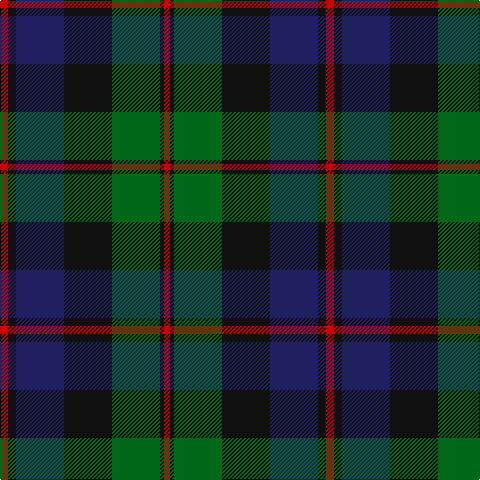
Black Watch (Coarse Kilt)
In pattern RKBKGKR.
This was sourced from register-of-tartans. It is a 7 stripes tartan.
Original link https://www.tartanregister.gov.uk/tartanDetails.aspx?ref=279
Thread count
R/8 K8 DB48 K48 G48 K4 R/6

Palette
Each colour and its ΔE from the base-6 reference it is a variant of.
| Colour | Shade | Base | ΔE (OKLab) |
|---|---|---|---|
| DB | #202060 #202060 | B #2C4084 | 0.11 |
| G | #006818 #006818 | G #006400 | 0.02 |
| K | #101010 #101010 | K #000000 | 0.17 |
| R | #C80000 #C80000 | R #C80000 | 0.00 |
Sample pattern
Nearest tartans
The nearest existing variants by ΔTartan distance.
- National Galleries of Scotland Corporate Tartan Tartan Number: 2050. Earliest known date: November 1991 Based on the Black Watch or Government tartan. The three claret stripes represent the three galleries and the colour is that of William Playfair's original colour scheme for the National Gallery. See products available Copyright © Blair Urquhart, Comrie, 2015 — ΔT 0.53
- Gunn Clan Tartan Tartan Number: 708. Earliest known date: c.1810-15 The Cockburn collection, housed in the Mitchell library in Glasgow, contains some of the oldest actual specimens of clan tartans in existance today. James Logan recorded the sett in his book 'The Scottish Gael' in 1831. The central blue stripes are often reproduced in black or very dark blue, giving the impression of four equally toned stripes. See products available Copyright © Blair Urquhart, Comrie, 2015 — ΔT 0.56
- Reid and Taylor — ΔT 0.60
- National Galleries of Scotland — ΔT 0.64
- Gunn — ΔT 0.68
- Dundas #2 — ΔT 0.76
- Blair Clan Tartan Tartan Number: 416. Earliest known date: pre 1963 Described by MacKinlay as a "Modern family sett". See products available Copyright © Blair Urquhart, Comrie, 2015 — ΔT 0.78
- Unnamed 19th Century Plaid — ΔT 0.80
- Renfrew — ΔT 0.80
- Baird (Old) Clan Tartan Tartan Number: 273. Earliest known date: c.1906 This tartan is first recorded in Johnston's work of 1906, and the sample from the Highland Society of London probably dates from the same period. In both these early references the triple stripes are rendered in red. Today, however, they are generally woven in purple. The name originates from 'bard' meaning poet. The Bairds owned estates in Aberdeenshire which were later purchased by the Gordons. See products available Copyright © Blair Urquhart, Comrie, 2015 — ΔT 0.82
Neighbour map
Every grey dot is one of 15726 variants placed by the first two principal components of the ΔTartan feature space (44% of its variance). Red is this tartan; blue dots are its nearest — click one to open its page.
ID: /setts/s7/r8k8b48k48g48k4r6-b202060-g006818-k101010-rc80000/