Culloden Dress Ancient
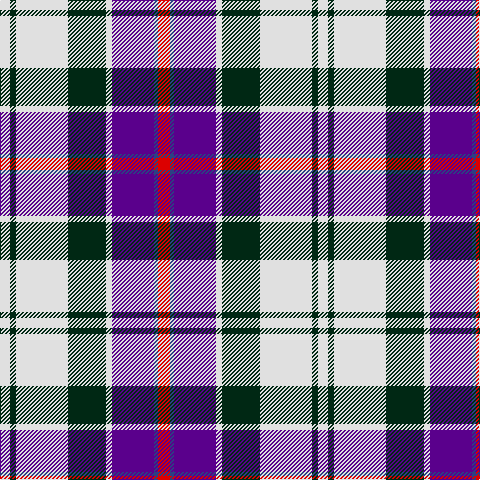
In pattern RBBWBWBW.
This was sourced from register-of-tartans. It is a 8 stripes tartan.
Original link https://www.tartanregister.gov.uk/tartanDetails.aspx?ref=824
Thread count
LN/10 DG6 LN52 DG38 LN6 P42 B4 R/12

Palette
Each colour and its ΔE from the base-6 reference it is a variant of.
| Colour | Shade | Base | ΔE (OKLab) |
|---|---|---|---|
| B | #2C4084 #2C4084 | B #2C4084 | 0.00 |
| DG | #002814 #002814 | B #2C4084 | 0.21 |
| LN | #E0E0E0 #E0E0E0 | W #F4F4F0 | 0.06 |
| P | #5A008C #5A008C | B #2C4084 | 0.12 |
| R | #DC0000 #DC0000 | R #C80000 | 0.04 |
Sample pattern
Nearest tartans
The nearest existing variants by ΔTartan distance.
- Culloden Dress Old Tartan Tartan Number: 1322. Earliest known date: 1983 Worn by a member of Prince Charles' staff during the battle but it is not known with which family or district it was first connected. It was first illustrated in Old & Rare in 1893 by D W Stewart whose son D C Stewart was a founder member of the Scottish Tartans Society. Now firmly established as a district tartan. See products available Copyright © Blair Urquhart, Comrie, 2015 — ΔT 0.38
- Culloden, dress Ancient — ΔT 0.47
- Ailsa Craig Trade Tartan Tartan Number: 1673. Earliest known date: 1972 Nothing See products available Copyright © Blair Urquhart, Comrie, 2015 — ΔT 0.66
- Davidson (Wedding) (Personal) — ΔT 0.70
- Davidson, Bride's — ΔT 0.79
- Stewart of Appin, dress — ΔT 0.87
- Ferguson Dress #2 — ΔT 0.91
- Ailsa, Craig — ΔT 0.91
- Stewart of Appin Dress Clan Tartan Tartan Number: 481. Earliest known date: pre 2003 The Stewarts of Appin fueded relentlessly with the Campbells, and they were supported in these pursuits and other military activities by some of the Clan MacColl, whose tartan is very similar. The Stewarts of Ardshiel, a branch of the Appin Clan, have a certified tartan of their own dating back to the 1820's, which has elements of the Appin design. Stewarts of Appin are descended from Dugald, the son of Sir John Stewart of Lorne who was murdered in 1463. Dugald established the Appin branch of the family by dividing his lands between his five sons. The tartan is worn by the Stonehaven pipe bands. See products available Copyright © Blair Urquhart, Comrie, 2015 — ΔT 0.92
- Stuart/Stewart of Appin Dress — ΔT 0.95
Neighbour map
Every grey dot is one of 15726 variants placed by the first two principal components of the ΔTartan feature space (44% of its variance). Red is this tartan; blue dots are its nearest — click one to open its page.
ID: /setts/s8/r12b4ba42w6bb38w52bb6w10-b2c4084-ba5a008c-bb002814-rdc0000-we0e0e0/