Tilburg (District)
This is one variant — a specific cloth: this exact thread count and colourway, with its own provenance below. It is one weaving of the sett (the scale-free proportion — the same cloth at any scale or shade), whose colour order is pattern BGBWR.
Part of the Tilburg tartan — the named design grouping this sett with its other cloths.
Sourced from tartans-authority. It is a 5 stripe tartan.
Original link http://www.tartansauthority.com/tartan-ferret/display/7464/ — retired · Internet Archive copy
2 attestations — the source records this cloth was collapsed from (oldest owns this page)
- Aug 2007 — Tilburg (District) (tartans-authority, record)
Concept from Alastair Gillespie and design by Marjan Stoop of AaBe Textiles of Tilburg. (www.aabe.nl) Tilburg was liberated during World War II by the 15th Scottish Division on 24th October 1944 and Alastair Gillespie and his organisation Scotfest (www.scotfest.nl) suggested to the Tilburg Mayor that the two tartans would cement the bonds between Tilburg and Scotland. Tilburg uses blue and yellow as their city colours amd the tartans will be used for kilts and to decorate one or more meeting places in the town. Tilburg was traditionally known as the wool capital of the Netherlands and in the 17th century there were more than 300 looms in the city and by 1881 there were around 145 woollen mills. The industry collapsed in the 1960s and now there is but one mill remaining - AaBe. Tilburg is between Rotterdam and Eindhoven just north of the Belgian border. - undated — Tilburg (register-of-tartans, record)
Concept from Alastair Gillespie and design by Marjan Stoop of AaBe Textiles of Tilburg. (www.aabe.nl) Tilburg was liberated during World War II by the 15th Scottish Division on 24th October 1944 and Alastair Gillespie and his organisation Scotfest (www.scotfest.nl) suggested to the Tilburg Mayor that the two tartans would cement the bonds between Tilburg and Scotland. Tilburg uses blue and yellow as their city colours and the tartans will be used for kilts and to decorate one or more meeting places in the town. Tilburg was traditionally known as the wool capital of the Netherlands and in the 17th century there were more than 300 looms in the city and by 1881 there were around 145 woollen mills. The industry collapsed in the 1960s and now there is but one mill remaining - AaBe. Tilburg is between Rotterdam and Eindhoven just north of the Belgian border.
Dataset — provenance for this record, inherited from the source manifest
- source
- Scottish Tartans Authority
- data captured from
- https://github.com/thetartan/tartan-database/blob/master/data/tartans-authority/data.csv
- data date
- Aug 2007 (this record)
- licence
- CC BY-NC-ND 4.0
Capture chain — the hands this data passed through, oldest first; each capture carries its own licence
- Scottish Tartans Authority
the heritage body’s archive — its tartan-ferret record browser is retired; dead record links are shown unlinked, with an Internet Archive copy (ITI numbers are not SRT references) - thetartan/tartan-database 2016-2017 · CC BY-NC-ND 4.0
Levko Kravets's frozen compilation — the capture we vendored, and where its CC licence text came from - this dictionary captured 2026-06-10 · commit 5bf86c7566
each re-capture is a git commit to data/sources
Register references
External register numbers recorded for this tartan.
- Scottish Register of Tartans: 5509
- Scottish Tartans Authority (ITI): 7464
Thread count
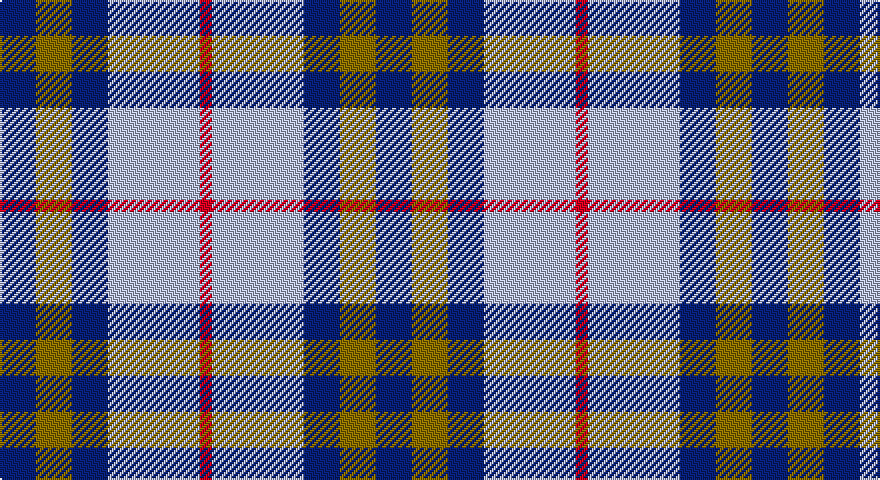
DB/18 Y18 DB18 LB46 R/6
One full sett is 188 threads.

Palette
| Colour | Shade | OKLCh |
|---|---|---|
| LB | #B5BBDE #B5BBDE | oklch(79.9% 0.050 277.6) |
| DB | #082077 #082077 | oklch(30.0% 0.149 265.1) |
| Y | #8B6E00 #8B6E00 | oklch(55.1% 0.113 90.4) |
| R | #D60020 #D60020 | oklch(55.2% 0.224 25.5) |
Sample pattern
Nearest tartan variants
The nearest existing variants by ΔTartan distance, with this cloth at the top so the swatches line up against it.











Neighbour map
Every grey dot is one of 13662 variants placed by the first two principal components of the ΔTartan feature space (42% of its variance). Red is this tartan; blue dots are its nearest — click one to open its page. The map is a flat projection of a many-dimensional space — how to read it.
ID: /variants/s5/db9y9db9lb23r3~x2/