Falkirk District Tartan
This is one variant — a specific cloth: this exact thread count and colourway, with its own provenance below. It is one weaving of the sett (the scale-free proportion — the same cloth at any scale or shade), whose colour order is pattern KBKBKBGGR.
Part of the Falkirk tartan — the named design grouping this sett with its other cloths.
Sourced from house-of-tartan. It is a 9 stripe tartan.
Original link http://www.house-of-tartan.scotland.net/house/TartanViewjs.asp?colr=Def&tnam=2347
Provenance
Earliest known date: 1989 The original Falkirk "Tartan" , now in the National Museum of Scotland, has a place in history as one of the earliest examples of Scottish cloth in existence. It is a direct link back to the Roman occupation of the area around 250 A.D.and was found stuffed into a pot filled with over 2000 silver coins. This early Celtic tweed used undyed yarn to give a herringbone pattern in brown hues and is considered to be a "poor man's plaid". The Falkirk District Tartan is alive with vibrant colour to reflect that part of Scotland as it is seen today. It was the winning entry by Jim McGeorge (aided by Tony Murray of Stirling) in a public competition run by Falkirk Town Centre Management to create a new image for an area that was rising from the ashes of its former industrial glory. Brown - represents the dominant colour of the original cloth; blue - links Falkirk district with sea via the River Forth and the canals. It is also the colour of the Falkirk "Bairns." Red - is the colour of the blast furnace flames from the Falkirk foundries and yellow - signifies wealth and prosperity. Black - the black lines intersect on blue to show Falkirk at the crossroads of all roads through the region.
Dataset — provenance for this record, inherited from the source manifest
- source
- House of Tartan
- data captured from
- https://github.com/thetartan/tartan-database/blob/master/data/house-of-tartan/data.csv
- data date
- 1989 (this record)
- licence
- CC BY-NC-ND 4.0
Capture chain — the hands this data passed through, oldest first; each capture carries its own licence
- House of Tartan
the weaver/retailer's database — the site is now offline; the URL is kept as the ultimate source's identity - thetartan/tartan-database 2016-2017 · CC BY-NC-ND 4.0
Levko Kravets's frozen compilation — the capture we vendored, and where its CC licence text came from - this dictionary captured 2026-06-10 · commit 5bf86c7566
each re-capture is a git commit to data/sources
Thread count
K/8 T8 K4 T8 K4 T44 DY54 Y4 R/6
One full sett is 266 threads.
The source recorded this cloth as R/6 Y4 DY54 T44 K4 T8 K4 T8 K8 T8 K4 T8 K4 T44 DY54 Y/4 — 522 threads; it folds to the canonical 266-thread sett above.

Palette
| Colour | Shade | OKLCh |
|---|---|---|
| T | #00879F #00879F | oklch(57.4% 0.102 216.1) |
| DB | #082077 #082077 | oklch(30.0% 0.149 265.1) |
| DR | #55120C #55120C | oklch(30.0% 0.099 29.3) |
| LO | #FF9C34 #FF9C34 | oklch(77.9% 0.161 61.8) |
| K | #000000 #000000 | oklch(0.0% 0.000 0.0) |
| R | #D60020 #D60020 | oklch(55.2% 0.224 25.5) |
| DY | #3A2B0D #3A2B0D | oklch(30.0% 0.049 82.0) |
| Y | #8B6E00 #8B6E00 | oklch(55.1% 0.113 90.4) |
Sample pattern
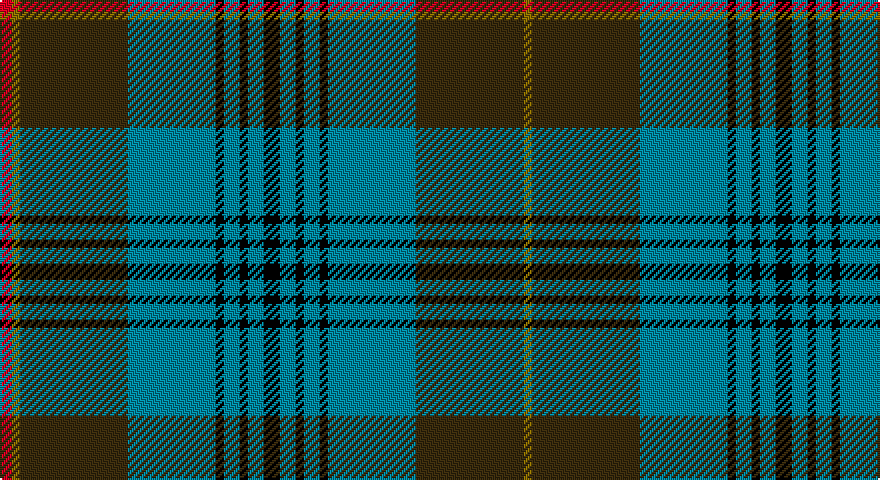
Compared to the master
This cloth is one sett of its design; the master sett (the exemplar the design is anchored on) is below for comparison.
Its ΔTartan distance from the master is 0.18 — the same measure the nearest-tartans table ranks by (0 is identical; a re-scale of the same cloth is near 0, a recolour or a different proportion further).
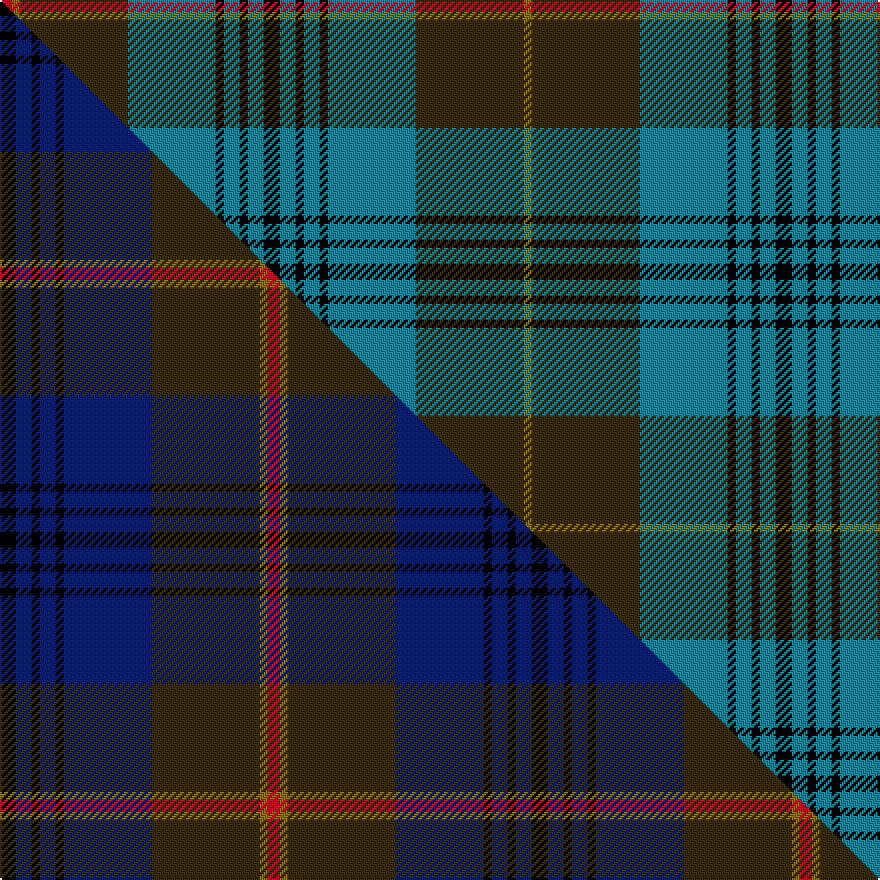 this sett
master sett ★
this sett
master sett ★Nearest tartan variants
The nearest existing variants by ΔTartan distance, with this cloth at the top so the swatches line up against it.











Neighbour map
Every grey dot is one of 13662 variants placed by the first two principal components of the ΔTartan feature space (42% of its variance). Red is this tartan; blue dots are its nearest — click one to open its page. The map is a flat projection of a many-dimensional space — how to read it.
ID: /variants/s9/k4t4k2t4k2t22dy27y2r3~x2/