Forbes
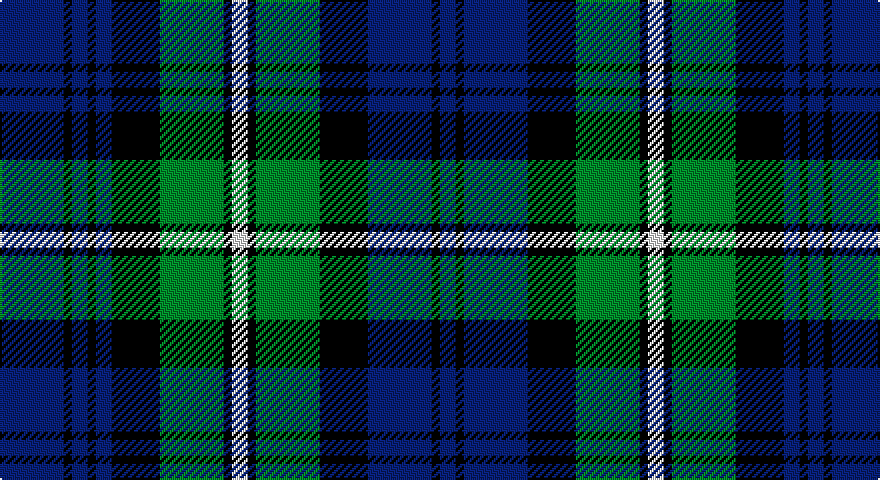
This is one variant — a specific cloth: this exact thread count and colourway, with its own provenance below. It is one weaving of the sett (the scale-free proportion — the same cloth at any scale or shade), whose colour order is pattern BKBKBKGKWKGKBKB.
Part of the Forbes tartan — the named design grouping this sett with its other cloths.
Sourced from register-of-tartans. It is a 15 stripe tartan.
Original link https://www.tartanregister.gov.uk/tartanDetails.aspx?ref=1214
2 attestations — the source records this cloth was collapsed from (oldest owns this page)
- 01/01/1819 — Forbes (register-of-tartans, record)
Blue lightened to show sett. Scottish Tartans Society Notes: This is the Forbes in use today. It was said to have been designed by a Miss Forbes in 1822 for the Forbes family of Pitsligo but earlier records would appear to discount this story. It appeared in Wilson's pattern book of 1819, in Grant No: 15 and in Smith No: 47. A different sett has been approved by the Clan Chief and registered with Lord Lyon. It is known as Forbes Ancient - see #212 (original Scottish Tartans Authority reference). W and A Smith 1850 Authenticated Tartans of the Clans and Families of Scotland say The correctness of the Forbes Tartan here given, seems to be, in the opinion of the Trade, a matter beyond the slightest doubt: it was once worn by the 74th regiment, but that corps now wear the Lamont. Also worn by the Liverpool Scottish. The Liverpool Scottish was formed as an infantry battalion in 1900 in response to the crisis of the Boer War. It was raised from amongst the body of highly educated and professional young Scotsmen in the city as the 8th (Scottish) Volunteer Battalion, The King's (Liverpool Regiment). There was an annual subscription of 10 shillings (50p) and an entrance fee of 2 pounds. The first Commanding Officer was Colonel C. Forbes Bell V.D. The Forbes tartan kilt was adopted by the regiment and the Highland full dress uniform featured a khaki tunic with scarlet collar and facings together with a feather bonnet or glengarry and tartan plaid. The earliest known date from a list compiled by D.C. Stewart from Wilsons of Bannockburn letters is 1827. - 1819 — Forbes - 1819 (Clan) (tartans-authority, record)
Blue lightened to show sett. This is the Forbes that is in use today. It was said to have been designed by a Miss Forbes in 1822 for the Forbes family of Pitsligo but earlier records would appear to discount this story. It appeared in Wilson's pattern book of 1819, in Grant No: 15 and in William and Andrew Smith's 1850 "Authenticated Tartans of the Clans and Families of Scotland" where they wrote: "The correctness of the Forbes Tartan here given, seems to be, in the opinion of the Trade, a matter beyond the slightest doubt: it was once worn by the 74th regiment, but that corps now wear the Lamont." The Lamont is the same as the Forbes but minus the black guards on the white. A different Forbes sett was approved by the Clan Chief and registered with Lord Lyon in November 1949. Known as Forbes Ancient - see # 212 - there is modern doubt as to its accuracy and it is surmised that an error has been made in recording it in the Lord Lyon's book - investigation continues (Jan 2008). Today's Forbes is also worn by the Liverpool Scottish. The Liverpool Scottish was formed as an infantry battalion in 1900 in response to the crisis of the Boer War. It was raised from amongst the body of highly educated and professional young Scotsmen in the city as the 8th (Scottish) Volunteer Battalion, The King's (Liverpool Regiment). There was an annual subscription of 10 shillings (50p) and an entrance fee of 2.GBP. The first Commanding Officer was Colonel C. Forbes Bell V.D. The Forbes tartan kilt was adopted by the regiment and the Highland full dress uniform featured a khaki tunic with scarlet collar and facings together with a feather bonnet or glengarry and tartan plaid. The earliest known date from a list compiled by D C Stewart from Wilsons of Bannockburn letters is 1827.
Dataset — provenance for this record, inherited from the source manifest
- source
- Scottish Register of Tartans
- data captured from
- https://github.com/thetartan/tartan-database/blob/master/data/register-of-tartans/data.csv
- data date
- 1819 (this record)
- licence
- Crown copyright
Capture chain — the hands this data passed through, oldest first; each capture carries its own licence
- Scottish Register of Tartans · Crown copyright
the living register — still published by National Records of Scotland - thetartan/tartan-database 2016-2017 · CC BY-NC-ND 4.0
Levko Kravets's frozen compilation — the capture we vendored, and where its CC licence text came from - this dictionary captured 2026-06-10 · commit 5bf86c7566
each re-capture is a git commit to data/sources
Register references
External register numbers recorded for this tartan.
- Scottish Register of Tartans: 1214
- Scottish Tartans Authority (ITI): 211
- Scottish Tartans World Register: 211
Thread count
DB/32 K4 DB8 K4 DB8 K24 G32 K4 W8 K4 G32 K24 DB32 K4 DB/8
One full sett is 416 threads.

Palette
| Colour | Shade | OKLCh |
|---|---|---|
| DB | #082077 #082077 | oklch(30.0% 0.149 265.1) |
| G | #008B2A #008B2A | oklch(55.4% 0.170 145.9) |
| K | #000000 #000000 | oklch(0.0% 0.000 0.0) |
| W | #F7F7F7 #F7F7F7 | oklch(97.6% 0.000 89.9) |
Sample pattern
Nearest tartan variants
The nearest existing variants by ΔTartan distance, with this cloth at the top so the swatches line up against it.











Neighbour map
Every grey dot is one of 13662 variants placed by the first two principal components of the ΔTartan feature space (42% of its variance). Red is this tartan; blue dots are its nearest — click one to open its page. The map is a flat projection of a many-dimensional space — how to read it.
ID: /variants/s15/db8k1db2k1db2k6g8k1w2k1g8k6db8k1db2~x4/